How Climate Change Is Affecting Women and Youth in South East Nigeria
Climate Change as a Lived Reality in South East Nigeria
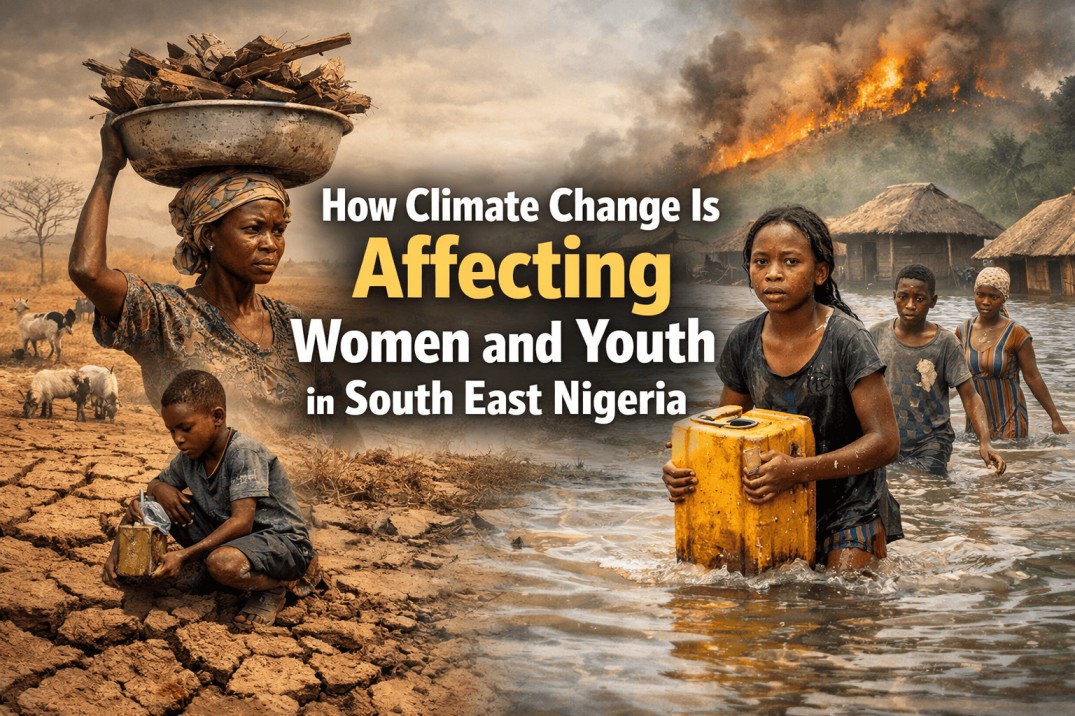
In South East Nigeria, climate change is no longer a distant environmental concern—it is a daily reality shaping how people live, work, and survive. Across states such as Enugu, Anambra, Imo, Abia, and Ebonyi, communities are experiencing increasingly severe flooding, accelerated gully erosion, prolonged dry spells, and unpredictable rainfall patterns.
These climate impacts are not gender- or age-neutral. Women and youth—who make up a significant share of the region’s agricultural workforce and informal economy—are bearing the heaviest burden. As livelihoods collapse and social systems are strained, climate change is deepening existing inequalities and threatening the future of an entire generation.
Overview of Climate Impacts in the Region
South East Nigeria is one of the country’s most environmentally vulnerable zones. Key climate-related challenges include:
- Severe flooding that destroys homes, farmlands, and local markets
- Gully erosion that cuts off communities, displaces families, and reduces arable land
- Erratic rainfall patterns that disrupt planting cycles and reduce crop yields
- Rising temperatures that worsen water scarcity and increase health risks
These impacts undermine food security, reduce household income, and weaken already fragile rural economies. For communities that depend heavily on smallholder farming and natural resources, climate change directly translates into poverty, displacement, and loss of opportunity.
Why Women Are More Exposed to Climate Risks
Women in South East Nigeria are disproportionately affected by climate change due to their social roles and economic positioning.
First, women carry the primary responsibility for food production, household care, and water collection. When floods destroy farms or drought reduces harvests, women must work harder to feed families with fewer resources.
Second, many women operate within the informal economy—as subsistence farmers, petty traders, food processors, or market vendors. These livelihoods offer little protection against climate shocks. A single flood or erosion event can wipe out years of effort with no access to insurance or credit for recovery.
Third, limited access to land ownership, finance, and climate information reduces women’s capacity to adapt. Without targeted support, climate change reinforces gender inequality and traps women in cycles of vulnerability.
How Youth Livelihoods and Futures Are Disrupted
Youth across South East Nigeria face a different but equally severe climate reality. Agriculture remains one of the largest employers of young people, yet climate instability makes farming increasingly unattractive and economically risky.
As climate impacts reduce productivity:
- Youth unemployment and underemployment rise
- Rural–urban migration accelerates
- Young people disengage from agriculture without viable alternatives
Many youths lack access to climate-resilient skills, green jobs, or entrepreneurship opportunities. Without intervention, climate change threatens to produce a generation locked out of decent work, increasing the risk of social unrest, poverty, and irregular migration.
Social and Economic Consequences for Households and Communities
The combined impact on women and youth ripples through entire communities. Households experience declining income, reduced food availability, and increased care burdens. Children—especially girls—may be withdrawn from school to support household survival.
At the community level, climate shocks weaken local markets, strain social cohesion, and reduce the capacity of communities to respond collectively to future crises. Over time, this erodes resilience and undermines long-term development.
Why Targeted Interventions Are Urgently Needed
Generic climate responses are not enough. Effective solutions must be deliberately designed around women and youth, who are both the most affected and the most capable of driving change when empowered.
Urgent priorities include:
- Climate-smart agriculture training for women and young farmers
- Access to finance and productive assets for women-led enterprises
- Youth-focused green skills and climate entrepreneurship programs
- Community-based adaptation and early warning systems
- Inclusive policy engagement that centers marginalized voices
Targeted interventions not only reduce vulnerability—they unlock women and youth as leaders in climate resilience and sustainable development.
Conclusion: The Case for Women- and Youth-Centered Climate Action
Climate change in South East Nigeria is as much a social and economic challenge as it is an environmental one. Women and youth stand at the intersection of vulnerability and opportunity. Ignoring their specific needs will deepen inequality; investing in them will strengthen resilience for entire communities.
Women and youth centered climate action is not charity—it is a strategic pathway toward inclusive growth, food security, and sustainable development. Supporting these groups today determines whether South East Nigeria adapts and thrives, or continues to absorb escalating climate shocks.


About Post Author


